

There is a weird little college town surrounded by snow-capped mountains in northern Utah and on that college campus is a giant sculpture made of thousands of entwined willow branches weaved tightly together to create a whimsical structure, something you can walk through and stand under, a kind of Dr. Seuss wicker house. I wondered how many willow trees it took to make it.
Growing up, we had two weeping willow trees at our home in California, one in the front yard and one in the back yard. And we had two birch trees standing next to each other. As a kid, I would grab the many little seed pods from the birches, like tiny delicate pinecones, and crush them in my hands to spread the seeds like dust, either one at a time between my fingers or a few between my palms, rubbing my hands together in the exact same motion as when you roll snakes out of clay, the brown crumbs floating everywhere.
The willows were something else. They were perfect for a child. They unfortunately died too young. They both got sick, you see. First one and then the other, like two diseased twin sisters. They caught a catching illness, caused by some sloppy contamination of tree trimming tools. And then they succumbed. It is strange when a tree dies. You’re not exactly sure when it’s gone, truly gone, for good. But you know it’s not okay for a long while. The leaves don’t return. It feels like the tree is sad, going through a bout of melancholy. And then, I don’t know, one day the pallor changes, just like a person. The blood runs right from their face and the tree turns grey as a ghost. And then those dead willows just stood there, for a long time, rampike facing rampike, their branches denuded and getting less and less good for climbing. We cut one of them down. The other finally fell one night during a thunder storm, and there it laid, too burdensome to remove, and kind of charming in its supinity. Its ragged bark eventually sloughed away, leaving the branches smooth as madrone.
But before this they were both alive, and they lived at the best time for me to experience them. They were perfect sanctuaries, their vines skirting all the way to the ground. There was a circle of grass beneath the willow that my father had planted in the backyard. That’s the tree I spent the most time with. This is what I think about when I think about that willow. I think of the wind rustling the bitter tasting leaves (of course I tasted them). I think of the long shiny smooth vines after I pulled their leaves off, grabbing as many as I could in a single yank, burning my hand from the friction, the leaves formed into a bouquet between my thumb and forefinger. I think of the trunk’s rough bark with its deep ravines, ravines that could be used for climbing. I think of the roots disturbing the earth. I think of its circus tent umbrella deep cool green canopy enveloping my boyish frame, giving me a place to hide. Children love to hide themselves. They love it. They love to be ensconced in the safety of small spaces. To be so close to the ground and its offering of towering tiny things that they become the whole world entire. By the time I was old enough to climb the nearest branch of the willow I was possessed less by the wonderment of close proximity to the ground and more by achieving maximalist feats. How high can I climb? How many steps can I go out on this limb? From how far can I jump without injuring my legs too much? But before those stunts was just the grass, the leaves, the dangling vines low enough for a toddler to reach. I miss feeling small like that, you know? I can certainly now feel dwarfed by nature, insignificant in the cosmos, fragile in the ecosystem. But that smallness of childhood is something else entirely. It is close. It is curious. It is impossibly intimate. Not fearful but assuring. Transportive into a world of the real, the immediate, the tactile, the sensatory, the inarguably living. So unnervingly close to the nothing that you came from. So close to the breath and the quick of things that you feel that you’ve known them all before, from some other where, though you’re but new to the world, and feeling that you will go on knowing these things of the world, forever grasping them tightly in your little child hands.
But people forget, don’t they? We take these things for granted. We believe assuredly that the bugs are still under the rocks if we only lift them up and look, the roly-polies and the earwigs scuttling for cover amongst the tiny desiccated snail shells. Are they really still? We believe that the bark is still rough and deep, that the leaves are still not worth eating, that the shaded earth is still cool and damp and refreshing. That the hidden world once revealed to us long ago is still there, keeping things afloat. And our senses inexorably stray from the ground. Our hands and our eyes and our noses and our ears and our mouths and our tongues and our lips ascend, without choice, higher and higher, away from the ground that bore us, that bore us so lovingly, that taught us of the world and its things, they climb upwards towards the churning clouds of maturity, our magnifying sense makers preoccupied now by more pressing uninnocent adult things, taken far and away from those once intricate details, from the cool and fresh and intoxicating effervescent soil. Do you remember what it smelled like? Do you? The cool dirt, shaded by a willow tree, its roots tilling beneath me, a tree destined to die before its time, well before me, before any children of my own, before the earth could be recovered, closer than it ever could be.
That’s what I think about when I think about those trees, the birches and the willows, all of them gone.
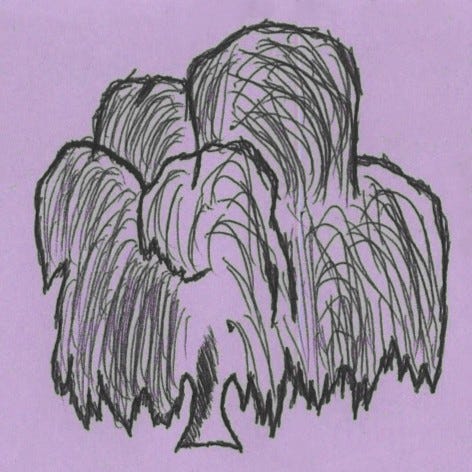
Beautiful, wonderful. I'm so sad that those trees died. Those willows were wonderful trees.